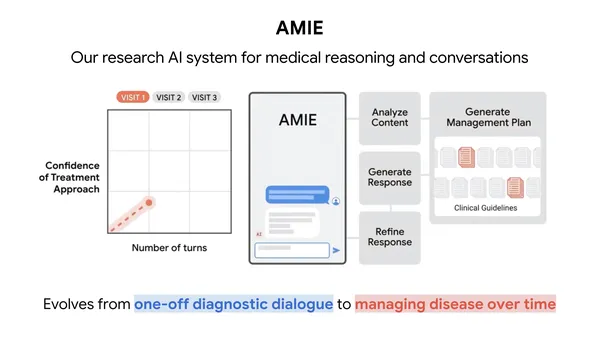

Google’s been pushing AMIE (Articulate Medical Intelligence Explorer) for a while now, and a fresh study published in Nature just gave it a serious credibility boost. The headline is that AMIE matched primary care physicians in managing complex health conditions. That’s not nothing.
Let me be clear upfront: I’ve seen a lot of “AI beats doctors” claims over the years, and most of them deserve side-eye. Benchmarks are often cherry-picked, tasks are simplified, or the comparison is against exhausted residents working 80-hour weeks. This one feels different.
The study focused on disease management — not just diagnosis, but the messy, ongoing work of adjusting treatments, handling comorbidities, and communicating with patients about lifestyle changes. Think diabetes management, hypertension, heart failure. The kind of stuff that makes up a huge chunk of primary care but doesn’t get the AI attention that radiology or pathology does.
AMIE was evaluated against board-certified physicians in a simulated environment. Both the AI and the doctors interacted with standardized patients (actors trained to portray specific conditions). The conversations were recorded, anonymized, and then scored by independent clinicians on things like diagnostic accuracy, management plan quality, communication skills, and empathy.
Here’s where it gets interesting: AMIE scored higher than the physicians on several communication metrics. It was rated as more empathetic, more thorough in explaining rationale, and better at asking about patient preferences. That surprised me, honestly. I’ve seen enough chatbot cringe to expect robotic, checklist-style interactions. But Google’s approach here leans heavily on reinforcement learning from human feedback (RLHF) and chain-of-thought reasoning, which seems to produce more natural dialogue.
On the clinical side — diagnostic accuracy and management plan appropriateness — AMIE was statistically non-inferior to the physicians. That means it wasn’t worse, but it also wasn’t clearly better. Which, for a first-of-its-kind study, is actually pretty damn good. If this were a drug trial, you’d call it a win.
Now, the caveats. This was a simulated setting, not a real clinic. The “patients” were actors, which removes the chaos of real human interactions — the crying, the confusion, the family members arguing in the background. AMIE also had access to a curated knowledge base and didn’t have to deal with incomplete medical records, insurance hassles, or any of the administrative garbage that eats up a doctor’s time.
But here’s the thing: that last point might actually be an argument for AMIE, not against it. If the AI can handle the cognitive load of complex management while the physician focuses on the human elements that machines still suck at — building trust, breaking bad news, navigating cultural sensitivities — then we’re talking about a tool that augments, not replaces.
I’ve been around long enough to know that every major AI company wants to “revolutionize healthcare,” and most of them fail. The regulatory hurdles alone are brutal. Google itself has had mixed results with previous health AI projects. But this study feels more grounded. It’s not promising to replace doctors; it’s showing that a well-designed conversational agent can hold its own in a domain that requires both medical knowledge and communication finesse.
The real test will be in deployment. Can AMIE integrate into existing clinical workflows without adding friction? Will patients trust it? Will physicians? Google has a history of building impressive demos that never quite make it to production. I’d love to see them prove me wrong here.
For now, this is a solid piece of research that moves the needle. It’s not the end of doctors as we know them. It’s a glimpse of a future where AI handles the heavy lifting of disease management, and physicians get to focus on what they trained for: actually caring for people.
Comments (0)
Login Log in to comment.
Be the first to comment!