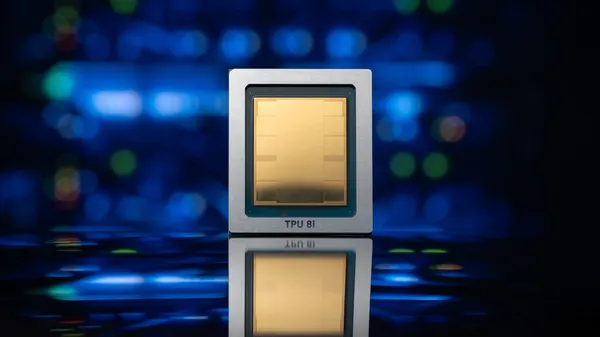

You probably don’t think about the hardware behind your Google searches, Gmail suggestions, or YouTube recommendations. But there’s a custom chip doing the heavy lifting—the Tensor Processing Unit, or TPU.
Google designed TPUs from scratch over a decade ago, and they haven’t stopped iterating since. The idea is simple: AI models are just math, lots of it, and general-purpose CPUs or even GPUs aren’t always the most efficient way to run that math at scale. So Google built its own silicon.
The latest generation hits 121 exaflops of compute power. That’s 121 quintillion floating-point operations per second. Bandwidth is also double what the previous generation offered. These numbers are ridiculous in absolute terms, but what matters is what they enable—models that would have been impractical or impossibly slow just a few years ago are now running in production.
I’ve watched TPU generations roll out since the first one appeared in 2015. Each iteration has been a meaningful step forward, but this jump feels different. The bandwidth doubling alone suggests Google is betting hard on models that need to move massive amounts of data between memory and compute units—think large language models and multimodal systems.
There’s a video embedded in the original announcement that walks through the chip design and how TPUs fit into Google’s data centers. It’s worth watching if you’re into hardware, but the short version is: Google isn’t just consuming AI hardware from NVIDIA or AMD—they’re building their own, and they’re getting better at it every cycle.
That said, TPUs aren’t a magic bullet. They’re designed specifically for TensorFlow and JAX workflows, so if you’re running PyTorch or something more exotic, you might not see the same performance. And Google’s TPU ecosystem is tightly coupled with its cloud platform—you can’t just buy one and plug it into your own server rack.
Still, for what they’re built to do, TPUs are impressive. 121 exaflops in a single pod is the kind of number that makes you realize how far AI hardware has come in a decade. And given how fast model sizes are growing, I suspect we’ll see another jump sooner rather than later.
Comments (0)
Login Log in to comment.
Be the first to comment!