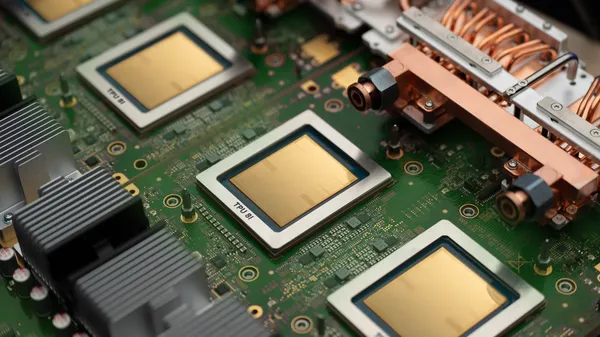

Google just dropped the eighth generation of its TPU lineup, and this time they’re not trying to do everything with one chip. Instead, they’re launching two specialized variants: one optimized for training, one for inference. That’s a notable shift.
For years, the TPU family has been a single-purpose workhorse, iterating on a unified architecture that handled both phases of machine learning. With gen eight, Google is acknowledging what many in the industry have been saying: training and inference are fundamentally different problems, and they benefit from different hardware designs.
The training chip is built for scale. Larger memory bandwidth, higher compute density, and the kind of raw throughput that makes distributed training across thousands of chips feasible. Inference, on the other hand, gets a chip that prioritizes low latency and energy efficiency. This is particularly interesting because the inference chip is specifically designed for the “agentic era”—Google’s phrase, not mine—meaning it’s supposed to handle the kind of multi-step, tool-using, context-heavy workloads that agent-based systems throw at it.
I’ve seen a lot of hardware announcements over the years, and most of them promise the moon. But this split makes real sense. If you’ve ever tried to run a complex agent pipeline on a chip tuned for training throughput, you know the pain: high latency, wasted compute, and a lot of thermal throttling. A dedicated inference chip that’s lean and fast could actually make agents feel responsive.
That said, I’m curious about the software story. Google has always leaned on its internal stack—XLA, JAX, TensorFlow—to make TPUs sing. If third-party frameworks like PyTorch don’t get first-class support on these new chips, the adoption outside of Google’s own cloud will be limited. And let’s be honest: most agent workloads today run on NVIDIA or AMD hardware. Google needs to make the migration path compelling.
Also worth noting: the timing. We’re seeing a wave of specialized AI hardware from everyone—Amazon’s Trainium, Microsoft’s Maia, even startups like Groq and Cerebras. Google isn’t first to the specialization game, but they have the advantage of vertical integration. They control the chip, the compiler, the framework, and the cloud. If they can make the whole stack work seamlessly for agentic workloads, they might have something genuinely useful.
I don’t think this is a game-changer overnight. But it’s a smart, pragmatic evolution. The era of one-size-fits-all AI accelerators is ending, and Google just drew a clearer line between training and inference than most competitors have dared to.
Comments (0)
Login Log in to comment.
Be the first to comment!