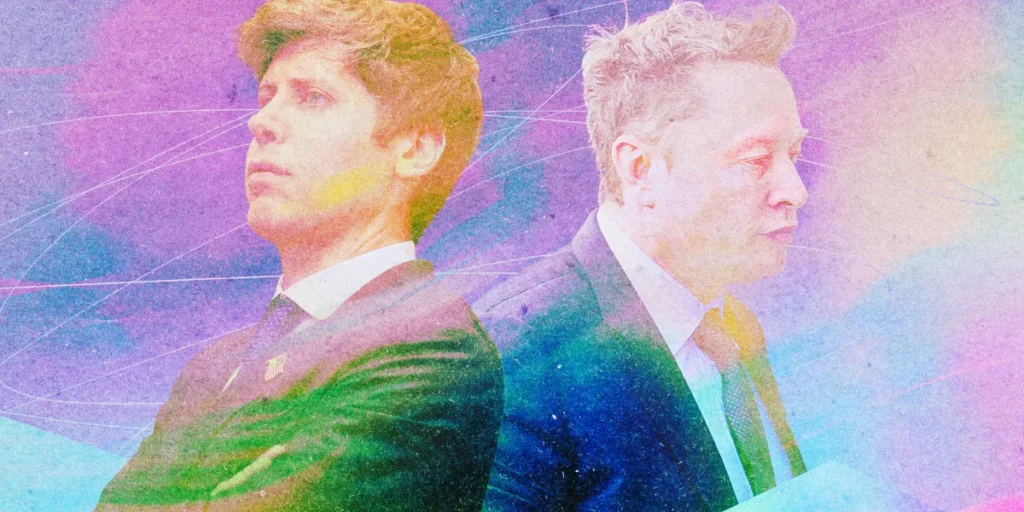

After years of legal threats, depositions, and public sniping, Elon Musk and Sam Altman are finally going to trial this week in Northern California. The case is messy, personal, and has consequences far beyond OpenAI’s boardroom.
At its core, this is a fight about whether OpenAI can exist as a for-profit company. Musk, who co-founded OpenAI in 2015 and donated $38 million to get it off the ground, says Altman and president Greg Brockman tricked him. His claim: they promised to keep OpenAI a nonprofit dedicated to open-source AI for humanity’s benefit, then quietly pivoted to a for-profit structure once his money was locked in.
Musk left OpenAI in 2018 after a power struggle, and he’s been nursing that grudge ever since. Now he wants as much as $134 billion in damages from OpenAI and Microsoft, and he’s asking the court to remove Altman and Brockman from their roles. Interestingly, he’s not asking for the money personally — he wants any damages awarded to OpenAI’s nonprofit arm.
Nine jurors will deliver an advisory verdict, which is non-binding but will guide the judge. Altman, Brockman, and Musk himself will all testify. So will former OpenAI chief scientist Ilya Sutskever, ex-CTO Mira Murati, and Microsoft CEO Satya Nadella. Expect cringey texts, raw diary entries, and a lot of scheming to come to light. For an industry that thrives on secrecy, this trial is a rare chance to see how the sausage was made.
What’s the actual dispute?
OpenAI started as a nonprofit with a noble mission: build AI that benefits everyone, share it openly, and don’t worry about profits. But as the AI arms race heated up, the company decided that open-sourcing models was dangerous and that a nonprofit couldn’t raise enough capital to compete. MIT Technology Review first reported on these internal conflicts back in the day.
The court has already found that by 2017, Altman and Brockman wanted a for-profit arm, while Musk proposed merging OpenAI with Tesla. When Musk threatened to pull funding, Altman and Brockman assured him they’d stay nonprofit. Musk claims they then went behind his back and pursued the for-profit pivot anyway. OpenAI’s version is that Musk agreed a for-profit was necessary and even wanted to be CEO.
But even if Musk proves he was deceived, legal scholars question whether he has standing to sue. “The idea that Elon Musk can sue because he was a donor or used to be on the board is pretty puzzling,” says Jill Horwitz, a law professor at Northwestern who studies nonprofit law. “Typically, it’s up to the attorneys general to enforce charitable purposes.”
And that’s already happened. In October 2025, California and Delaware attorneys general struck a deal with OpenAI to approve its new structure under conditions — like a safety committee at the nonprofit reviewing for-profit decisions. California’s AG has declined to join Musk’s lawsuit, saying it doesn’t see how his action serves the public interest.
Still, whether that deal actually holds OpenAI to its mission is an open question. “Elon Musk should have to show what the deficiencies are in what’s been agreed to by OpenAI with the attorneys general,” says Rose Chan Loui, director of the UCLA School of Law’s nonprofit program.
What’s at stake?
OpenAI is reportedly planning an IPO that could value the company at hundreds of billions. A ruling that blocks its for-profit structure would throw that into chaos. The judge could also order Altman and Brockman removed, which would be a massive leadership vacuum at the most influential AI company on the planet.
Musk’s motives are harder to parse. He’s clearly still bitter about losing control of OpenAI, and he’s been building his own AI company, xAI, as a direct competitor. Some see this lawsuit as a strategic move to slow OpenAI down. Others think he genuinely believes the mission was betrayed. Probably both.
Either way, this trial is going to be a spectacle. The public will finally get a look at the messy, ego-driven early days of OpenAI — the texts, the backroom deals, the shifting promises. And the outcome could determine whether the most hyped AI company in history gets to keep its for-profit future.
Comments (0)
Login Log in to comment.
Be the first to comment!