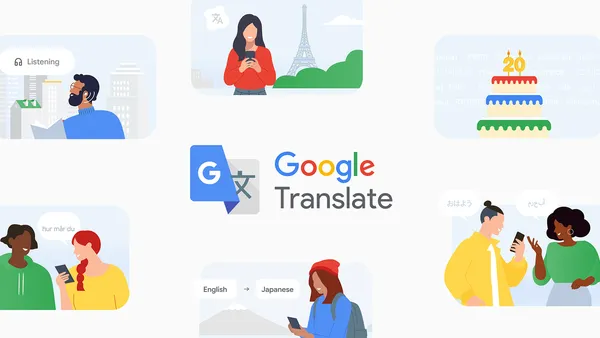

Google Translate turned 20 this week. Twenty years of feeding text into a box and hoping the output isn’t complete gibberish. I’ve been using it since the early days — back when it was mostly a party trick for embarrassing yourself in front of native speakers — and it’s genuinely interesting to see how far it’s come.
The company dropped a blog post with 20 “fun facts” to mark the occasion. Some of them are genuinely impressive. Others are the kind of self-congratulatory stats you’d expect from a corporate anniversary post. Let’s separate the signal from the noise.
The numbers that actually matter
Google Translate now supports almost 250 languages. That’s up from just two at launch in 2006 — Arabic and English, if you’re curious. The service processes over 100 billion words per day. To put that in perspective, that’s roughly the entire text content of the Library of Congress every few days. I don’t know about you, but that makes me feel slightly better about all the times I’ve relied on it to read a menu in a language I don’t speak.
The model architecture has shifted dramatically. The original system used statistical machine translation — basically pattern matching on a massive scale. In 2016, they switched to neural machine translation, which was a genuine leap forward. The difference between pre-2016 translations and post-2016 is night and day. Before the switch, you’d regularly get output that was technically correct but read like a robot with a concussion. Now it’s… well, it’s still not perfect, but it’s usable.
The fun facts that are actually fun
Some of the stats they shared are worth knowing. The most translated phrase in Google Translate history is “How are you?” — which is both wholesome and deeply boring. The single most translated word is “hello,” which tracks. The most requested language pair is English to Spanish, followed by English to Arabic and English to Portuguese. If you’re wondering why Portuguese beats French or German, it’s probably because of Brazil’s sheer population size and the volume of cross-border commerce.
One thing I didn’t expect: Google Translate now supports 37 languages that are considered “low-resource” — meaning they don’t have large digital corpora to train on. That’s not just a PR talking point. It’s genuinely difficult to build a translation system for a language like Quechua or Guarani when there’s barely any parallel text available. The fact that they’ve managed to do this at all is a technical achievement.
The new features that aren’t just fluff
Alongside the anniversary post, Google rolled out a few updates. The one that caught my eye is a new “contextual understanding” mode for the web interface. It’s supposed to handle idioms and culturally specific phrases better. I’ve been testing it with a few notoriously tricky phrases — “it’s raining cats and dogs” into German, “tomber dans les pommes” into English — and the results are noticeably better than before. Not perfect, but better.
There’s also a redesigned mobile app. The camera translation feature, which lets you point your phone at text and get a real-time overlay, now works with handwriting and stylized fonts. I tried it on a particularly ornate French restaurant menu and it handled it better than I expected. Still not something I’d rely on for a business meeting, but for travel purposes it’s genuinely useful.
The things nobody says out loud
Look, I use Google Translate almost daily. It’s a genuinely useful tool. But let’s not pretend it’s solved translation. The system still struggles with context-dependent words, sarcasm, and anything that requires understanding cultural nuance. Try translating a joke from Japanese into English and you’ll see what I mean. The output is often technically correct but completely misses the point.
There’s also the issue of bias. Multiple studies have shown that machine translation systems, including Google’s, tend to default to masculine pronouns and stereotypical gender roles. Google has made efforts to address this — they now offer gender-specific translations in some languages — but it’s far from solved.
And then there’s the privacy question. Every query you type into Google Translate goes to their servers. They’ve been clear about this, and they offer on-device translation for some features, but the default behavior is still cloud-based. If you’re translating sensitive documents, that’s something to keep in mind.
Where we go from here
Twenty years in, Google Translate is no longer a novelty. It’s infrastructure. It’s embedded in Chrome, in Android, in countless third-party apps. The next frontier is probably real-time conversation translation that doesn’t feel awkward. The current iteration works, but the latency and the robotic delivery make it feel like you’re talking through a walkie-talkie from 1995.
They’re also experimenting with multimodal models that can translate audio, images, and text simultaneously. I’ve seen demos of a system that can translate a live video feed in real time — point your phone at a street sign in Tokyo and see English text overlaid instantly. It’s impressive, but it’s not ready for prime time yet. The accuracy drops significantly when the text is partially obscured or the lighting is bad.
Overall, Google Translate has earned its place. It’s not perfect, but it’s free, it’s fast, and it covers more languages than any human translator ever could. That’s worth celebrating, even if the blog post is a bit heavy on the corporate cheerleading.
Happy birthday, Google Translate. You’ve come a long way from the days when I could reliably get a laugh by translating a sentence back and forth five times.
Comments (0)
Login Log in to comment.
Be the first to comment!