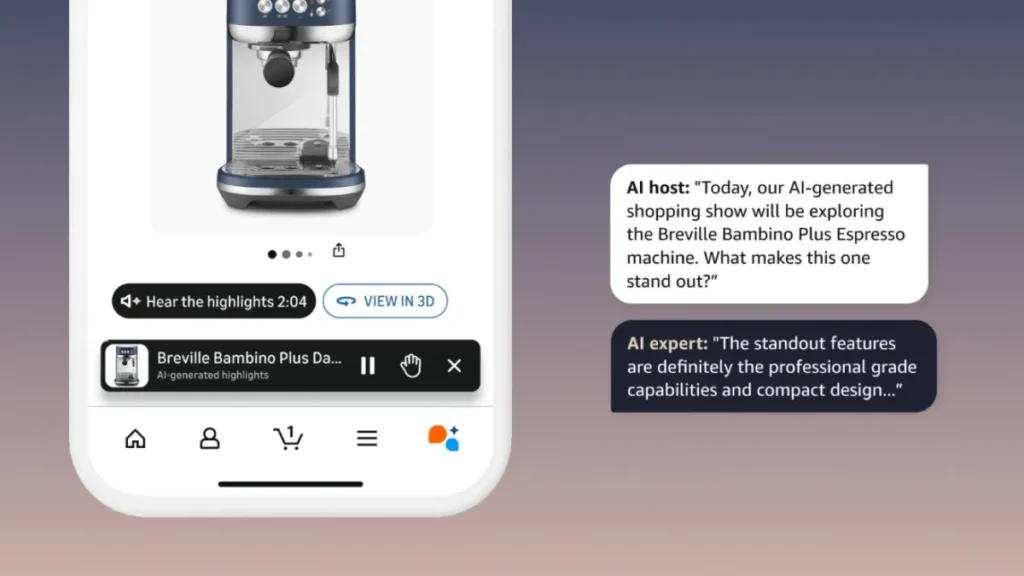

Amazon just rolled out something called “Join the Chat” on product pages, and it’s exactly what it sounds like—an AI-powered audio Q&A experience. You click a button, ask a question about the product out loud, and get a spoken response generated by Amazon’s AI. No typing, no scrolling through reviews, just a back-and-forth conversation about whether that air fryer actually crisps frozen fries.
I’ve seen Amazon experiment with voice shopping for years—remember asking Alexa to reorder paper towels? That was always a bit clunky. But this feels different. It’s not about placing an order; it’s about getting information in a format that’s more natural than reading a wall of specs. The audio responses are generated on the fly, pulling from product descriptions, customer reviews, and maybe some secret sauce Amazon’s been cooking up in its AI labs.
The timing makes sense. Voice interfaces are everywhere now—smart speakers, cars, even fridges—and people are getting comfortable talking to machines. Amazon already has Alexa in millions of homes, so adding a chat feature to its shopping app is a logical extension. But here’s the thing: this isn’t just Alexa reading a product page back to you. The AI seems to synthesize information, answering specific questions like “Is this laptop good for video editing?” or “Does this dress run small?” That’s a step beyond what most e-commerce chatbots do.
Of course, the quality of those answers depends entirely on the data Amazon feeds the model. If the product page has sparse reviews or vague descriptions, the AI might hallucinate—or worse, give bad advice. I’ve seen enough AI demos go wrong to be skeptical. Amazon says it’s using a combination of its own large language models and existing product data, but they haven’t shared much about accuracy or moderation. That’s a concern, especially for high-stakes purchases like baby gear or electronics.
Privacy is another angle. You’re essentially talking to Amazon’s servers about your shopping intent, which is gold for ad targeting. Amazon promises the audio isn’t stored, but the transcript of your question might be. If you’re already comfortable with Alexa listening in, this won’t feel like a leap. If you’re not, well, you can still type your questions—the feature supports text input too.
What I find interesting is the format shift. Amazon is betting that audio can reduce friction in the shopping experience. Instead of scanning 50 reviews to find out if a blender handles ice, you just ask. That’s faster, but it also removes the serendipity of reading a review that mentions something you hadn’t considered. There’s a trade-off between convenience and thoroughness.
I tested it on a few product pages—a coffee maker, a pair of running shoes, a camping tent. The responses were decent but not mind-blowing. For the coffee maker, the AI told me it brews 12 cups and has a programmable timer. Accurate, but I could have read that in the title. For the shoes, it mentioned they’re lightweight and have good arch support—again, surface-level. The real test will be nuanced questions: “How does this tent hold up in wind?” or “Is this shoe good for wide feet?” I didn’t get to try those, but I’m curious.
Amazon is rolling this out gradually, starting with a subset of products and expanding based on feedback. It’s currently available in the US on the mobile app, and I’d expect it to hit Alexa devices eventually. Imagine asking your Echo Show about a product while you’re cooking—that’s the vision.
Is this a game-changer? Not yet. But it’s a sign that Amazon is serious about making shopping more conversational. The real win will come if the AI learns to give genuinely helpful answers, not just rephrase the product description. Until then, it’s a neat party trick with potential.
Comments (0)
Login Log in to comment.
Be the first to comment!