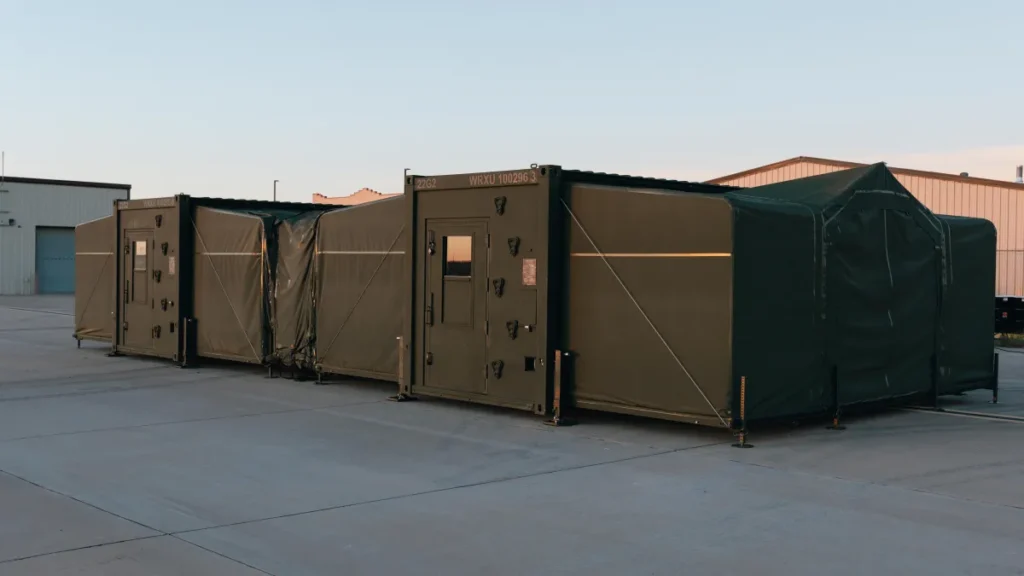

A defense startup just raised $82 million to put drone factories inside shipping containers and bring manufacturing to the front lines.
Firestorm Labs, a San Diego-based company that’s been quietly building what it calls “deployable manufacturing systems,” just closed an $82 million Series B. The round was led by some big names in defense tech, though the company isn’t naming all of them yet. What I find interesting isn’t just the money — it’s the premise: take a full drone assembly line, shrink it down to fit in a standard shipping container, and ship it to wherever the fight is.
The idea isn’t entirely new. We’ve seen pop-up factories in disaster relief and oil rigs, but applying this to drone manufacturing for active combat zones feels like a logical next step. The military has been struggling with supply chains for years. If you can’t get drones fast enough from a factory in Ohio to a base in the Middle East, why not just build the factory closer to the problem?
Firestorm’s system is modular. Each container handles a specific part of the production process — frame assembly, electronics integration, final testing. You link a few together and you’ve got a functioning drone factory that can be trucked, flown, or shipped anywhere. The company claims they can go from container drop-off to first drone off the line in under 72 hours. That’s aggressive, but if true, it’s a game-changer for rapid response.
The drones themselves are the “Tempest” series — small, expendable UAVs designed for reconnaissance and loitering munition roles. They’re not meant to be fancy. They’re meant to be cheap, fast to produce, and easy to replace. Firestorm says each container setup can crank out dozens per day, depending on configuration. That kind of volume matters when you’re dealing with attrition rates in modern warfare, where drones get shot down faster than traditional supply chains can replace them.
I’ve seen a lot of defense startups promise “disruption” and deliver PowerPoint slides. Firestorm has actually been flying these things in Ukraine for over a year, according to sources familiar with the matter. Real-world testing, not just lab demos. That gives the $82M raise a bit more weight than your typical VC-fueled defense hype.
Of course, there are risks. Operating a manufacturing line in a contested environment is not the same as running one in a secure facility. Power, parts resupply, and security all become harder when your factory is a container in a field. Firestorm says they’ve hardened the systems for battlefield conditions, but I’d want to see how they hold up after weeks of sand, vibration, and potential electronic warfare interference.
The funding will go toward scaling production of the containerized factories themselves — yes, they need to build factories to build factories — and expanding the Tempest drone lineup. They’re also hiring, which is always a good sign for a startup that actually needs to deliver hardware.
What I like about this approach is that it sidesteps one of the biggest bottlenecks in military tech: the slow, centralized supply chain. Instead of building one giant factory and hoping it doesn’t get bombed, you distribute production across dozens of small, mobile units. Lose one, and you’ve still got others running. That’s resilience through redundancy, which is something the Pentagon has been talking about for years but rarely executes on.
Firestorm isn’t the only company chasing this idea. A few others have tried containerized manufacturing for smaller systems, but none at this scale or with this level of funding. The $82M gives them a real shot at making it operational.
I’ll be watching to see if the military actually adopts this at scale. The concept is sound, but defense procurement is famously slow and resistant to new models. If Firestorm can get a few of these container factories deployed in active theaters and keep them running for months, they’ll prove the model works. Until then, it’s a promising bet with real-world testing behind it — which is more than most defense startups can say.
Comments (0)
Login Log in to comment.
Be the first to comment!