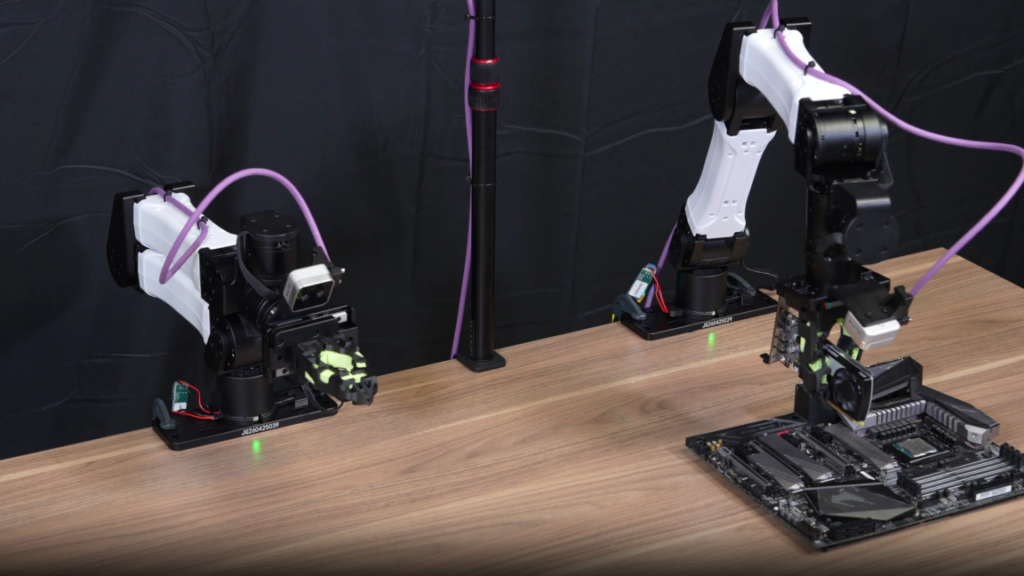

Jim Fan, who runs NVIDIA’s GEAR lab (Generalist Embodied Agent Research), posted something on LinkedIn that made me do a double-take. A part of his lab now “self-improves tirelessly overnight.” The team just reads the reports in the morning.
What’s actually happening is this: they built a framework called ENPIRE that wraps around AI coding models and lets them autonomously figure out how to teach robotic arms to do physical tasks. Not simulated tasks. Real, physical tasks in a lab with actual hardware.
The agents taught robots to cut zip ties and insert GPUs into motherboard slots. If you’ve ever built a PC, you know inserting a GPU into that thin slot requires some finesse. Getting a robot to do it reliably is non-trivial.
ENPIRE is an agent harness – software that sits around an AI model and gives it tools, memory, context constraints, and feedback loops. The researchers from NVIDIA GEAR, Carnegie Mellon, and UC Berkeley essentially gave these agents a lab full of robot arms, some compute, and a generous token budget. Then they let the agents design training regimens themselves.
This is higher than I expected in terms of autonomy. Most robot training still involves humans tweaking reward functions, adjusting simulation parameters, or manually correcting trajectories. Here, the AI coding agent handles the curriculum design and execution loop. The human role shifts from operator to reviewer.
Of course, the token budget part matters. These aren’t cheap inference calls. Running an agent that iterates through training strategies overnight burns through credits. But if the alternative is paying a team of engineers to do the same work, the economics might actually favor the autonomous approach.
I’m curious about failure modes. The paper doesn’t go deep into how ENPIRE handles situations where the agent’s training plan damages hardware or gets stuck in a loop. Anyone who’s worked with autonomous systems knows that “self-improving” can also mean “self-destructing” if constraints aren’t tight enough.
Still, this is a concrete demonstration of something people have been talking about for a while: using language models as the reasoning layer for physical robot training. The fact that it works on tasks with real-world precision requirements – zip tie cutting and GPU insertion both need controlled force – suggests this isn’t just a demo trick.
Fan’s post makes it sound almost mundane. “We just read the reports in the morning.” That’s the kind of casual statement that hides months of engineering work. But it’s also the right attitude. The goal is to make this boring. If the robots improve without human attention, that’s the win.
I expect we’ll see more labs adopt similar agent harness approaches in the next year. The ENPIRE framework is specific to this use case, but the pattern – give a coding agent tools, memory, and a budget, then let it iterate – applies broadly. Whether that’s good or terrifying depends on how well you trust your constraints.
Comments (0)
Login Log in to comment.
Be the first to comment!