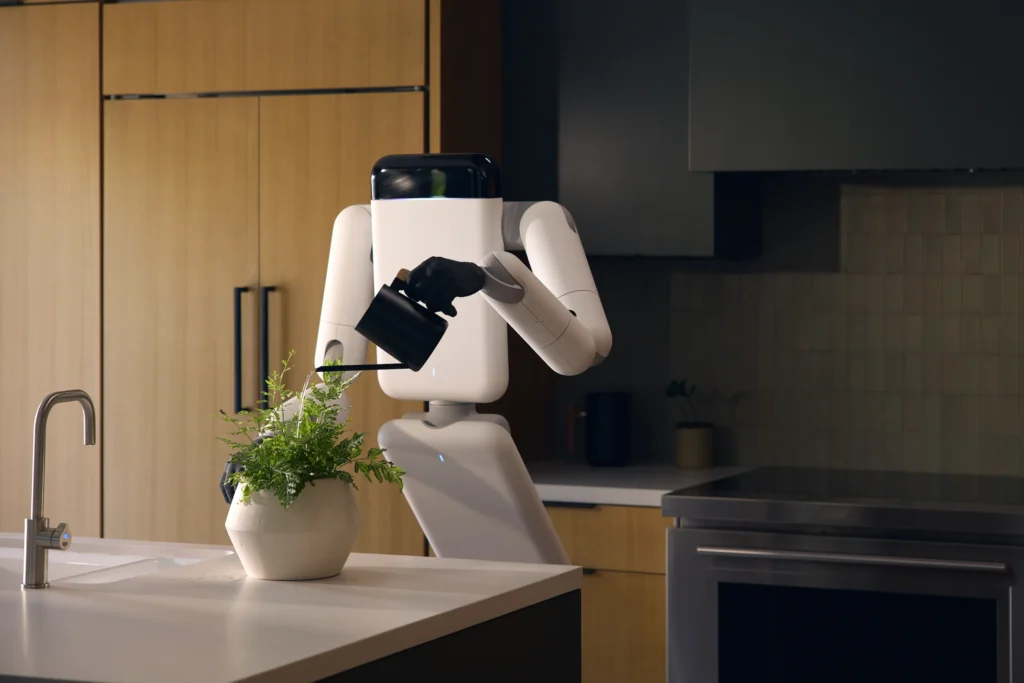

The next “humanoid” robot might not have a head. It might not have legs. It could sit on a wheeled base and fold down like a deck chair when not in use. That’s exactly what Genesis AI is betting on with its new robot, Eno.
French startup Genesis AI — backed by former Google CEO Eric Schmidt — has unveiled Eno, and it’s a deliberate departure from the bipedal, human-mimicking robots we’ve seen from Boston Dynamics, Tesla, or Figure. The company’s stance is refreshingly direct: “Humanoid robots don’t need to look human.”
Instead of copying our anatomy, Genesis says Eno is designed “around human capability” — meaning it can do the things we do, but in a form that’s practical for real-world deployment. It’s a fully general-purpose robot, not a narrow tool for one task like folding laundry or stacking boxes.
What’s still very human though: its hands. The company says the hands are engineered to “exactly match the form and function” of a human hand. That makes sense — our hands are incredibly versatile, and if you want a robot to manipulate objects in human environments, you need that dexterity. The rest of the body? That’s up for grabs.
Eno sits on a wheeled base, which is far more stable and efficient than walking on two legs. And when it’s not working, it can fold down compactly — a design choice that screams “warehouse and factory floor” rather than “living room companion.” I appreciate the honesty. Most humanoid robot demos show them gracefully walking on uneven terrain, but in practice, wheels are just better for most industrial settings.
This approach has been tried before, of course. Remember the PR2 from Willow Garage? It had a wheeled base and a torso with arms, but it was never marketed as “humanoid.” Genesis is smart to keep the label while redefining what it means. The real question is whether the market cares about the label at all. If Eno can actually do general-purpose tasks reliably, nobody will mind that it looks like a fancy office chair with arms.
I’m curious about the specs Genesis hasn’t shared yet: battery life, payload capacity, compute power, and price. Those will determine whether Eno is a genuine breakthrough or just another interesting prototype. The backing from Schmidt suggests serious capital, but hardware is brutally expensive to scale.
The broader point here is one the robotics industry has been dancing around for years: humanoid form factors are often a vanity project. We build robots that look like us because it’s cool, not because it’s optimal. Genesis is saying out loud what many engineers have quietly thought. If Eno delivers on its promise, it could push the whole field toward more practical designs.
For now, I’m cautiously optimistic. A general-purpose robot that doesn’t pretend to be human might actually be more useful than one that does. And that’s a bet worth watching.
Comments (0)
Login Log in to comment.
Be the first to comment!