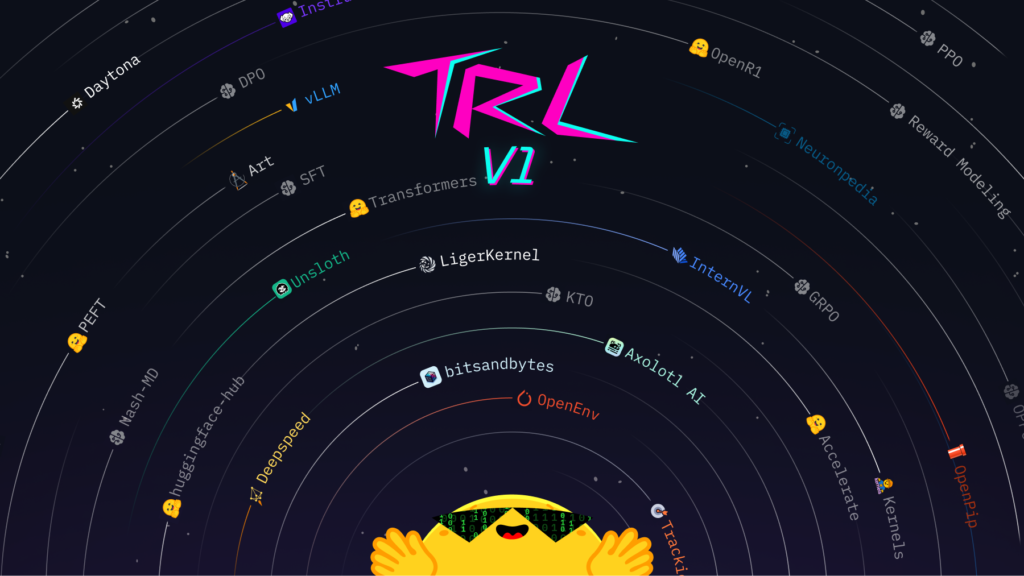

Hugging Face released TRL v1.0 today, and this isn’t one of those feel-good version bumps where they just clean up the docs and call it a day. This is the library acknowledging it’s been running production systems for a while now, and it’s time to act like it.
TRL started as a research codebase—the kind of thing you hack together to test a paper, not something you’d trust with actual workloads. But the numbers tell a different story: 3 million downloads a month, projects like Unsloth and Axolotl building directly on top of it. A breaking change in TRL doesn’t just break your experiments anymore; it breaks someone else’s product. That’s a responsibility shift, and v1.0 is the formal recognition.
The field won’t sit still, so the library learned not to either
Post-training has been a moving target from day one. PPO made it look like you needed a policy, a reference model, a learned reward model, sampled rollouts, and an RL loop. Then DPO came along and said “actually, you don’t need half of that.” Then GRPO said “actually, rewards can come from deterministic verifiers, not learned models.”
The lesson isn’t that methods change—it’s that the definition of what’s core keeps changing. Strong assumptions in this space have a short half-life. That’s probably why no post-training library is really stable yet. TRL v1.0 doesn’t pretend to have solved that; it just designed around it.
The design philosophy: chaos-adaptive, not chaos-proof
Here’s the counterintuitive bit: TRL v1.0 doesn’t try to capture the essence of what’s stable today. Instead, it designs around what could change. Reward models are the perfect example—they looked essential in PPO, became optional in DPO, and came back as verifiers in GRPO. Any abstraction built around their original form would have been obsolete twice over by now.
The library survives by making changeability central to how the codebase is organized. That sounds like a recipe for chaos, but it’s actually the opposite: by acknowledging that assumptions have a short shelf life, you build in the flexibility to swap them out without breaking everything.
Stable and experimental, under the same roof
The most interesting design choice in v1.0 is how it handles the tension between stability and innovation. The stable core follows semantic versioning—break nothing, change nothing unexpectedly. The experimental layer makes no such promises. New methods land there while they’re still being evaluated, and the API can move fast to keep up with the field.
This isn’t a compromise. It’s a response to a specific constraint: the field produces new methods faster than any of them can earn stability. Refusing to add immature methods would make TRL irrelevant within months. Adding them all to stable would break every downstream project every time an algorithm turned out not to work as expected.
So you get both. From the same package:
from trl import SFTTrainer  # stable
from trl.experimental.orpo import ORPOTrainer  # experimental
Promotion from experimental to stable isn’t automatic. It depends on the ratio between maintenance cost and actual usage. Some methods earn their place because the community uses them heavily. Others become viable because the design of the codebase makes them cheap enough to maintain.
What’s actually in the stable surface
As of v1.0, the stable trainers include SFT, DPO, Reward modeling, RLOO, and GRPO, along with their close variants. The experimental surface is broader and moves faster—for an up-to-date view, the docs are your best bet.
The breaking changes needed to reach v1.0 were distributed deliberately across the 0.x releases, so the transition shouldn’t feel like a rug pull. If you’ve been keeping up with the release notes, most of what’s changing now is already familiar.
My take
I’ve been watching TRL evolve for a while, and this release feels like the right move at the right time. The post-training space is still figuring itself out—we’re not at the point where anyone can say “this is the one true method.” A library that tries to pretend otherwise is going to have a bad time.
What I like about TRL v1.0 is that it doesn’t pretend. It says “here’s what we’re confident in, here’s what we’re still figuring out, and here’s how we keep both working without breaking your stuff.” That’s honest engineering, and it’s exactly what a field like this needs.
Is it perfect? No. The experimental/stable split adds complexity, and you’ll need to pay attention to which surface you’re importing from. But given the alternative—either stagnate or break everyone’s code every few months—this is the better trade-off.
If you’re building on top of TRL, v1.0 is worth the upgrade. If you’ve been waiting for a stable foundation to start, now’s the time.
Comments (0)
Login Log in to comment.
Be the first to comment!