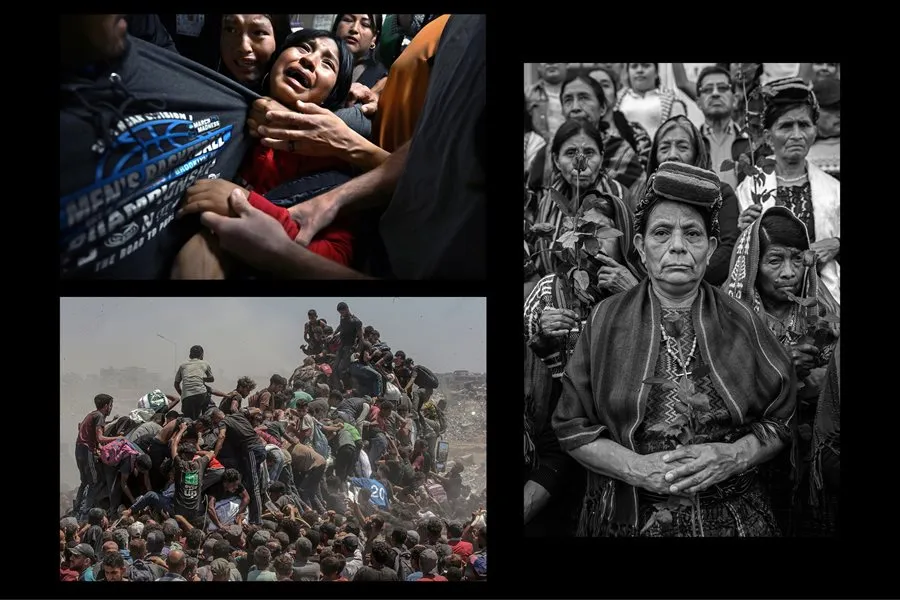

The World Press Photo competition has been around for decades, and it’s always been about one thing: capturing real moments. Not staging them, not enhancing them, not generating them. Just pointing a camera at something that actually happened and pressing the shutter.
This year’s winner, announced yesterday, is Carol Guzy’s “Separated by ICE.” It shows children clinging to their father after an immigration hearing. It’s the kind of image that stops you cold. You don’t need to know the backstory to feel the weight of it. But if you do know the backstory, it hits even harder.
Guzy is no stranger to this stage. She’s a three-time Pulitzer winner, and her work has always been about documenting the human cost of policy decisions. This photo fits right into that body of work.
But here’s the thing that caught my attention: the rules. The World Press Photo organization has been tightening its stance on AI tools for a while now, and this year they made it crystal clear. If you want to be in the running, you can’t use generative AI to create or alter the content of your image. No adding things that weren’t there. No removing things that were. No generating elements from scratch.
This is higher than I expected, honestly. I’ve seen other competitions waffle on this, trying to find a middle ground where “AI-assisted” is somehow different from “AI-generated.” World Press Photo just drew a line. A photo is a recording of light reflecting off something real at a specific moment in time. If you didn’t capture that light, you didn’t take that photo.
I’ve been thinking about this a lot lately, because the question “what is a photo?” has become genuinely confusing. You see these hyper-realistic AI images on social media, and people argue about whether they “count” as photography. Some photographers are using AI upscaling or denoising tools and calling it “digital darkroom” work. Others are generating entire scenes from text prompts and slapping a “photography” label on it.
The World Press Photo approach is refreshingly simple: if you couldn’t have made it with a camera in your hand, it’s not a photo. Period.
Of course, this doesn’t solve every edge case. What about computational photography? What about the AI denoising that’s baked into modern camera sensors? What about the HDR stacking that happens automatically on your phone? The rules address this too, but it’s a nuanced conversation. The line they’ve drawn is about generative AI specifically, not about the computational tools that have been part of digital photography for years.
I think that’s a reasonable distinction. There’s a difference between processing the data you captured and inventing data that wasn’t there. One is editing. The other is creating.
Carol Guzy’s photo doesn’t need any AI enhancement anyway. The raw moment is enough. A father, his children, the cold reality of the immigration system. That’s the power of photojournalism. No prompt engineering required.
Comments (0)
Login Log in to comment.
Be the first to comment!